How to Check Authentic Rolex Watch: 5 Easy Verification Methods
The Counterfeit Problem Every Rolex Buyer Needs to Know About

Before you commit to a pre-owned luxury watch purchase, knowing how to check whether a Rolex watch is authentic can help you avoid expensive mistakes. A genuine Rolex has precise physical details, movement behaviour, and engraving quality that most replicas still struggle to match.
Here are the key takeaways to check first:
- The Cyclops lens magnifies the date exactly 2.5 times
- The seconds hand sweeps smoothly and silently
- The serial number is laser-engraved sharply on the rehaut for post-2008 models or between the lugs for pre-2005 models
- Oystersteel models usually weigh between 150 and 200 grams
- The case back is solid metal, not transparent
- Dial printing is crisp, evenly spaced, and free of smudging
- The laser-etched crown logo appears at 6 o'clock on the crystal on post-2002 models
Rolex produces around 1.2 million watches annually, and customs agencies seize hundreds of thousands of counterfeits each year. By 2026, high-end replicas have become convincing enough that even experienced collectors hesitate. The gap between a genuine Rolex and a replica has never been narrower, making verification essential.
The good news is that genuine Rolex watches still have specific, consistent features that fakes consistently get wrong. You just need to know where to look.
I'm Brad Purdy, founder of WristWorks, and every watch that comes through our business is opened, tested, and checked before it goes anywhere near a buyer, partly because I know how to check whether a Rolex watch is authentic and partly because I once lost $13,000 to a scam that tightened every process we now run. In the sections below, I'll walk you through exactly what to inspect, what to avoid, and how to buy with confidence in Australia.
Related Rolex authentication guides:
How to Check Whether a Rolex Watch Is Authentic: Physical and Visual Indicators
When you hold a genuine luxury timepiece, the first thing you notice is the uncompromising build quality. Genuine models are manufactured using highly specialised 904L stainless steel, known as Oystersteel, which offers incredible corrosion resistance and takes an exceptionally high polish.
Counterfeiters often rely on standard 316L stainless steel, which lacks the same lustre, weight, and density. Here is a direct comparison of genuine manufacturing standards versus common replica warning signs.
| Component | Genuine Rolex Feature | Counterfeit Red Flag |
|---|---|---|
| Metal Quality | High-polish 904L Oystersteel or 18k gold | Dull 316L steel, gold plating that wears off at edges |
| Case Back | Smooth, solid metal case back with no engravings | Clear glass exhibition back, or generic brand engravings |
| Date Window | Perfectly centred, crisp font with no blue reflection | Misaligned date, thin or smudged font |
| Winding Crown | One-piece solid crown with crisp, sharp knurling | Rough, uneven edges on the crown guards and grip |
For a deeper dive into these material differences, you can read LuxeDetect's 2026 Guide to understand how modern manufacturing trends affect pre-owned verification.
1. Inspecting the Cyclops Lens and Date Window
One of the most distinctive features of a date-complication model is the Cyclops magnification lens positioned directly over the date window. This small bubble of sapphire crystal is designed to make reading the date effortless.
On a genuine timepiece, the Cyclops lens magnifies the date by exactly 2.5 times. The numbers should fill the entire magnification bubble, appearing bold, crisp, and perfectly centred. Furthermore, the curve of the bubble is smooth and precise, creating a distinct "black hole" effect when viewed from an angle due to the anti-reflective coating applied underneath.
Many counterfeits struggle to replicate this exact magnification, often featuring lenses that only magnify by 1.5 times. This leaves the date looking small, thin, and difficult to read. When learning How to Spot a Fake Rolex, always start by examining the date window under a magnifying loupe to ensure the magnification is correct.
2. Examining the Seconds Hand Sweep and Movement
The movement of the seconds hand is a classic indicator of a genuine mechanical timepiece. Rather than the distinct "tick-tick-tick" of a standard quartz watch, a genuine mechanical model features a seconds hand that glides smoothly around the dial.
This smooth motion is achieved because the mechanical movement operates at 28,800 vibrations per hour (vph), translating to exactly eight micro-ticks per second. Because these ticks occur so rapidly, the human eye perceives it as a continuous, elegant sweep. If you hear a loud, audible ticking sound, the watch likely contains a cheap quartz movement.
While some high-end replicas use automatic movements to mimic this sweep, they fail to achieve the silent, fluid motion of a genuine calibre. A genuine movement runs almost silently. For advanced tips on analysing internal movements, check out these Expert Verification Tips.
How to Check Rolex Serial Numbers for Authenticity
Every genuine timepiece features a unique serial number that allows you to identify its production era. However, where and how this number is engraved depends entirely on the year of manufacture:
- Pre-2005 Models: Engraved on the side of the case, directly between the lugs at the 6 o'clock position. You must remove the bracelet to inspect this engraving.
- 2005 to 2007 Models: Engraved on the inner metal bezel ring, known as the rehaut, under the crystal, as well as between the lugs.
- Post-2008 Models: Engraved exclusively on the rehaut at the 6 o'clock position, visible without removing the bracelet.
On a genuine watch, these engravings are incredibly sharp, deep, and clean. Counterfeiters often use cheap acid etching, resulting in faint, dotted, or blurry numbers. To learn more about identifying specific production eras by their serial configurations, consult the Rolex Authenticity Guide for 2026.
4. Assessing Weight and Material Quality
A genuine luxury watch has a satisfying, substantial weight. Because the brand uses premium, dense materials like 904L Oystersteel, 18k solid gold, and 950 platinum, the watch feels solid on your wrist.
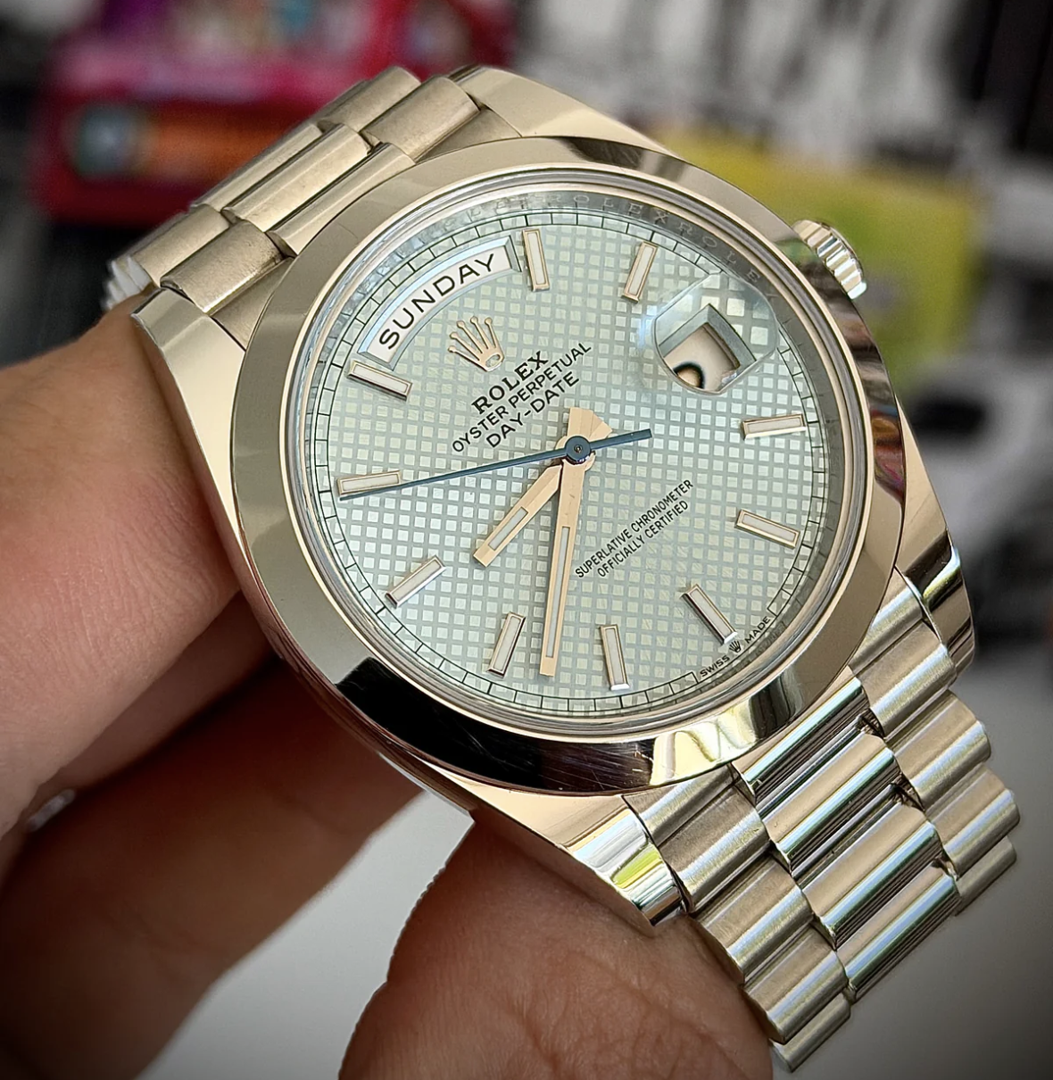
A standard Oystersteel model typically weighs between 150 and 200 grams, depending on the model and bracelet style. Precious metal models, such as a solid yellow gold Day-Date, weigh significantly more. Counterfeiters often use cheaper, lighter base metals or hollow components, resulting in a watch that feels noticeably light or flimsy.
When you hold a genuine bracelet, the links feel fluid yet robust, with no excess lateral play. If the watch feels suspiciously light or the bracelet links feel cheap and hollow, it is a strong indicator of a replica. You can read more about evaluating physical characteristics in our guide on How to Recognise a Real Rolex.
Checking Rolex Dial Details and the Laser-Etched Crown
The dial of a genuine timepiece is a masterpiece of precision engineering. The brand maintains incredibly strict quality control standards, meaning dial imperfections are virtually non-existent on genuine modern watches. When inspecting a dial, keep an eye out for these common replica flaws:
- Smudged Printing: Genuine text is crisp, slightly raised, and perfectly aligned. Counterfeits often display uneven fonts, ink bleeding, or misspelled words.
- Misaligned Hour Markers: The applied hour markers on a genuine watch are symmetrical and perfectly centred. Replicas often have slightly crooked markers or unevenly applied luminous paint.
- The Laser-Etched Coronet: On models produced from 2002 onward, a microscopic crown logo is laser-etched into the sapphire crystal at the 6 o'clock position. This etching is so small that it is almost invisible to the naked eye, requiring a jeweller's loupe and angled light to spot. Counterfeits often print this logo on the surface or etch it so crudely that it is easily visible without magnification.
For a comprehensive checklist of dial details and crystal markings, refer to the Complete Guide to Spotting Fakes.
Buying Safely from a Trusted Rolex Dealer in Australia
While performing a physical inspection is an excellent skill to develop, relying solely on a DIY approach carries significant risk. High-end replicas have become incredibly sophisticated, and verifying a luxury timepiece on a street corner or through a private online marketplace lacks the security and precision required for such a major purchase.
The single best way to protect yourself is to work with a reputable professional dealer. At WristWorks, we operate a digital-first model based in Perth, Western Australia, designed to make luxury watch trading transparent, secure, and straightforward. We own 95% of our inventory outright, meaning almost every watch we sell has been personally acquired, inspected, and verified through our rigorous testing processes before being listed. This hands-on approach ensures absolute quality, convenience, and customer satisfaction.
If you are looking to sell or trade your current timepiece, we always recommend direct-to-dealer sales as the primary, most secure option because of its speed and safety. For those who prefer an alternative route, we also offer a highly managed consignment service as an optional, secondary service. With this option, we hold and secure your watch in our secure facility while managing the entire process on your behalf, and all payments are handled directly by us to ensure a seamless transaction. If you are ready to find your next timepiece or sell an existing one, you can Enquire About a Watch directly through our team.
Choosing Trusted Dealers Over Private Sellers
Buying a luxury timepiece from a private seller on online marketplaces can expose you to unnecessary risks. Private transactions lack security, and verifying the paperwork or the condition of the watch without professional tools is far from ideal.
Furthermore, understanding watch care requires professional knowledge. For instance, while professional polishing is perfectly acceptable for modern watches to restore their original lustre, vintage pieces are generally left unpolished to preserve their historic value, original lines, and case geometry. A professional dealer understands these nuances and will always be transparent about the service history and condition of a timepiece.
Working with an independent specialist like WristWorks gives you the confidence of knowing that every watch has undergone a rigorous verification process. If you want to learn more about the steps involved in professional verification, explore our guide on How to Verify a Rolex to ensure you make a secure purchase.