

How to Tell if a Rolex Is Real Before You Buy

If you are considering a Rolex, start with the seconds hand, dial printing and overall build quality in good light. These early checks can reveal obvious concerns, but a convincing counterfeit can still pass a casual inspection, so pause if the case, bracelet, date display or paperwork feels inconsistent and compare it with reliable images of the correct model before deciding to proceed or arranging an inspection.
Key Takeaways
- Check the seconds hand, dial printing, date display and overall build quality before relying on any single detail.
- Compare the watch with clear images of the correct model and look for consistent finishing across the case, bracelet and clasp.
- Use a loupe to inspect the Cyclops lens, rehaut engraving and crystal coronet for clean, precise execution.
- Treat paperwork as supporting provenance, not proof on its own.
- Learn why Rolex seconds hands can appear to sweep, then arrange a professional inspection before committing to a purchase.
I am Brad Purdy, founder of WristWorks. Through hands-on work assessing pre-owned luxury watches, I have seen how small details in the movement, dial, case and paperwork can affect a buyer’s confidence. That practical experience informs the checks in this guide. It also helps buyers focus on the details worth questioning, compare the watch carefully and know when an independent inspection is worthwhile.
Practical Checks to Tell if a Rolex Is Real
Counterfeit watches can look convincing at first glance, so it helps to slow down and inspect the finishing rather than relying on one sign. Rolex uses carefully finished materials and tightly controlled components, but the most reliable assessment comes from considering several details together.
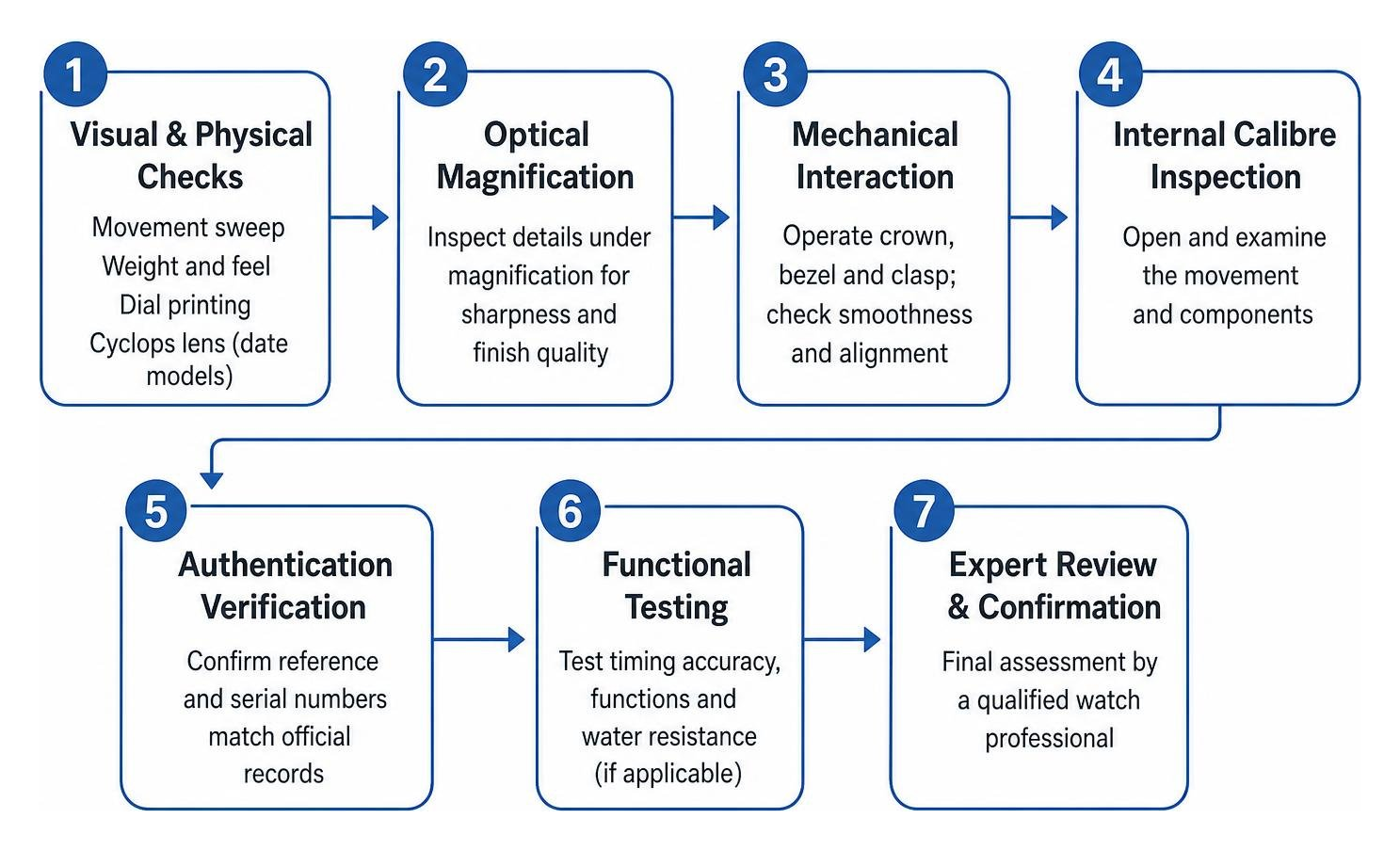
When evaluating a piece, follow a systematic screening hierarchy. A structured evaluation begins with external physical checks before moving to optical magnification, mechanical operation, and internal movement inspection.
Start with what you can see and feel: look at the case edges, bracelet fit and dial under good light, then move to magnification and movement behaviour. Take your time and avoid making a decision from a single impressive detail. A counterfeiter may reproduce one feature convincingly while leaving inconsistencies in the printing, alignment or finishing elsewhere. If the seller cannot provide clear photographs or allow a careful inspection, treat that limitation as useful information.
Weight and Movement Sweep
Weight can be a useful preliminary clue, but it varies with the model, bracelet, condition and any replacement parts. A watch that feels unusually light, poorly balanced or loosely assembled deserves a closer inspection, but weight alone cannot confirm whether it is real.
Movement mechanics offer a direct sensory check. Modern mechanical calibres operate at 28,800 vibrations per hour (4 Hz), advancing the seconds hand eight times per second to create a gliding sweep. If a seconds hand jumps once per second, the piece houses a cheap quartz movement.
A smooth-looking seconds hand can eliminate some basic imitations, but sophisticated automatic clones can imitate this movement pattern. Continue with the structural checks below rather than treating the sweep as a final answer.
| Check | What to Look For | Why It Matters |
|---|---|---|
| Weight and balance | A solid, even feel that suits the specific model and bracelet | Poor balance or light materials can indicate lower-quality construction |
| Seconds hand | Small, rapid steps that create a smooth-looking sweep | A once-per-second jump is a warning sign, though a smooth sweep is not proof |
| Cyclops lens | A clear, centred date that is easy to read | Weak magnification and poor alignment are common concerns |
| Crystal coronet | A subtle, precisely placed mark that is difficult to spot | An overly visible or crude mark deserves closer review |
| Rehaut engraving | Even lettering with consistent alignment | Uneven spacing or rough finishing can reveal poor replication |
Dial Precision, Cyclops Magnification, and Crystal Etching
Optical testing under a 10x loupe exposes flaws invisible to the naked eye. The Cyclops lens on genuine date models delivers an exact 2.5x magnification factor. The numeral beneath must appear crisp, centred, and occupy roughly 80% of the aperture vertically. Cheap counterfeits routinely feature 1.5x to 2.0x magnification, leaving excessive blank space around the date wheel.
Inspect dial typography and markers closely. Genuine dial text is printed cleanly without ink bleeding or bridging. Applied hour markers feature mirror-polished white gold surrounds with evenly poured luminous material. Modern references employ Rolex's proprietary Chromalight lume, which emits a 480nm blue glow under UV light and retains visibility for up to 12 hours. Counterfeit compounds typically glow green or fade quickly.
Modern Rolex sapphire crystals may include a micro-laser-etched coronet near the six o’clock position. The mark should be subtle and difficult to see without angled light; a crude or overly prominent version is a reason to investigate further.
Rehaut and Serial Engravings
The inner bezel wall (rehaut) serves as an essential checkpoint. Starting around 2005, Rolex introduced repeating laser-engraved "ROLEX" script along this perimeter:
- The letters "X" align precisely with hour markers on the right side (1 to 5 o'clock).
- The letters "R" align with hour markers on the left side (7 to 11 o'clock).
- A coronet sits centred at 12 o'clock, and the serial number is cut at 6 o'clock.
On older models, serial and model details may be engraved between the lugs. Look for clean, consistent grooves that catch the light evenly rather than shallow, rough or poorly aligned markings.
Caseback Design, Winding Crown, and Clasp Mechanics
Standard production Rolex models feature plain, solid metal casebacks without display glass or exterior engravings. An open display caseback on a standard Submariner or GMT-Master II indicates a counterfeit.
Winding crown operation reveals tight manufacturing tolerances. Screwing down a Twinlock or Triplock crown feels smooth and firm, requiring distinct, consistent rotations (typically 3.5 to 4.5 turns on a Submariner and 2.5 to 3 turns on a Datejust) to seat flush against the gasket. Counterfeits often feel gritty or wobbly.
Oyster and Jubilee bracelets should articulate smoothly without excessive rattle. The clasp should close securely and feel consistent, rather than gritty, loose or uneven.
When to Arrange a Professional Rolex Inspection
High-grade “super clones” can use steel, ceramic bezels and cloned movements that closely imitate the external dimensions and sweep mechanics of genuine watches. Superficial checks are not enough to identify these pieces with confidence.
Opening the caseback exposes the internal architecture. A genuine Rolex movement may feature:
- A free-sprung balance with Microstella regulating screws around the inner rim of the balance wheel.
- A purple-anodised aluminium reversing wheel.
- Carefully applied circular Geneva striping and perlage on the baseplate.
- A skeletonised nickel-phosphorus Chronergy escapement in compatible modern movements.
Counterfeit clone movements usually feature an ETA-style regulator index lever on the balance bridge, rough tool marks, or stamped bridges with irregular typography.
Super Clones, Documentation, and Watchmaker Verification
Electronic diagnostics on a professional Timegrapher offer definitive performance metrics. A genuine modern Rolex movement operates within a strict Superlative Chronometer tolerance of -2/+2 seconds per day. Acceptable baseline readings include:
- Amplitude between 270 and 320 degrees at full wind.
- Beat error below 0.3 milliseconds.
- Positional variance across six physical orientations remaining under 6 seconds per day.
Counterfeit movements typically exhibit lower amplitude, beat error exceeding 0.5 ms, and severe positional drift exceeding 15 to 20 seconds daily.
Documentation and packaging must be reviewed critically, as presentation boxes and guarantee cards can also be forged. Paperwork provides helpful provenance context, but it does not replace hands-on mechanical verification.
If you are unsure after these checks, do not rely on a seller’s description or a quick online comparison. A professional assessment can examine the movement, case, dial and paperwork together, giving you a clearer basis before deciding whether to buy or walk away.
When assessing condition or considering restoration, collectors should also note that cosmetic polishing is acceptable for modern production models to restore factory lustre, whereas polishing is generally avoided on vintage references to preserve original bevels and case thickness.
For buyers and sellers, a direct-to-dealer outright sale remains the primary and most secure way to trade a high-value timepiece, providing immediate, structured evaluation and straightforward payment handling. Selling privately through classifieds or handling an unassisted private sale leaves owners exposed to the risk of counterfeit disputes, payment delays, and complicated logistics that an established dealer avoids entirely.
At WristWorks, we own 95% of our inventory, hold all consigned pieces securely in our Perth facility and handle payments directly. Consignment is available as a secondary option, but a direct outright sale is generally the clearest route for sellers seeking a structured evaluation and straightforward process. Whether you are reviewing a watch or looking to explore our luxury watch collection, a professional inspection can provide clarity before you buy or sell. Use our watch enquiry portal to request an expert valuation.


