Watch Experts Share Advice on Value Retention
If you are wondering whether an expensive watch is likely to hold its value in Australia, the best advice usually comes from people who see real transactions every day, not just retail price lists. The right expert can help you understand what your watch may be worth now, what affects resale value, and which selling path is safest.
Key Takeaways
- In Australia, direct-to-dealer or outright selling is usually the simplest and safest option for owners who want a clear result without the risks of private selling.
- Value retention depends on brand demand, model desirability, condition, originality, box and papers, and local Australian buyer appetite.
- Independent valuers, auction specialists, pre-owned dealers, and market analysts all look at the market differently, so their advice is useful for different decisions.
- Australian pricing is shaped by global Swiss supply, the Australian dollar, GST, import costs, and local demand for particular models.
- Keeping records, avoiding unnecessary alterations, and preserving the original set can make a meaningful difference when it is time to sell.
Start With Specialists Who Understand the Australian Resale Market
A formal valuation and a realistic resale estimate are not always the same thing. For insurance, estate planning, or legal documentation, a registered jewellery valuer can provide a formal written appraisal. In Australia, the National Council of Jewellery Valuers is a recognised professional body for this type of work.
For a practical view of what a watch may sell for today, it is worth speaking with a specialist pre-owned dealer who buys and sells luxury watches in the local market. Dealers see current buyer behaviour, wholesale pricing, model liquidity, and how quickly particular references move. That makes them especially useful when you want to understand likely resale value rather than a replacement figure.
Auction specialists can also help when a watch is rare, vintage, or unusually collectible. They review past sale results and bidder demand, which can be useful for unusual pieces. For most owners, though, auction advice should be treated as one part of the picture rather than the only guide.
Know the Difference Between Replacement Value and Cash Market Value
One of the most common points of confusion is the gap between replacement value and cash market value. A replacement valuation may reflect what it could cost to replace the watch through a retail channel in Australia. A cash market value is closer to what a buyer, dealer, or collector may pay for that exact watch in its current condition.
That difference matters if you are planning to sell. A watch can have a strong replacement value while still selling for less than the original retail price on the secondary market. Before making a decision, it helps to compare formal valuation guidance with real pre-owned market evidence, including recent Australian listings and completed sales.
If you need a broader appraisal context for a collectible item, a specialist service such as an antique shop valuation and restoration service in Brisbane can show how replacement value and sale value may differ across valuable objects.
What Factors Decide Whether a Luxury Watch Holds Its Value?
The Australian market is influenced by global watch supply, local demand, and the details of the individual piece. Two watches from the same brand can perform very differently if one has stronger buyer demand, better condition, or a more complete ownership set.

Brand Demand and Controlled Supply
The watches that tend to hold value best are usually from brands with long-term demand and limited access to popular models. Rolex, Patek Philippe, and Audemars Piguet are often discussed in this context because many of their sports models have deep secondary-market demand.
That does not mean every expensive watch will perform well. Value retention depends on the exact model, reference, configuration, production period, and market appetite. A popular stainless steel sports model may be easier to sell than a precious metal dress watch with a narrower buyer pool. If you are researching the basics, WristWorks' guide to whether luxury watches hold their value explains how brand strength and buyer demand shape resale outcomes.
Condition, Originality, and the Full Set
Condition is one of the first things an expert will assess. Scratches, worn bracelets, damaged bezels, dial condition, and service history can all affect the final offer or sale price. For modern watches, careful professional polishing can sometimes improve presentation. For vintage watches, polishing is generally avoided because collectors often prefer original case lines, natural ageing, and untouched details.
The full set also matters. Original box, papers, spare links, tags, manuals, receipts, and service records can help support buyer confidence and improve resale appeal. Missing papers or aftermarket changes can reduce demand, even when the watch itself is desirable.
Australian Pricing, Currency, and Local Demand
Luxury watches are produced and priced through global supply chains, but Australian buyers feel the impact locally. The Australian dollar, import costs, GST, shipping, and availability through Australian channels can all influence what people are prepared to pay here.
When the Australian dollar weakens, imported stock can become more expensive, which may support local pre-owned pricing for some models. At the same time, higher interest rates or softer discretionary spending can reduce the number of active buyers. That is why local advice matters. A watch may look strong on an overseas index, but the real question is what Australian buyers are paying now.
For a local perspective, this WristWorks overview of the Australian watch market explains how local demand, availability, and buyer behaviour shape pricing.
How Should Australian Buyers and Sellers Act on Expert Advice?
Once you have a realistic view of value, the next step is choosing the safest way to act on it. For many Australian owners, direct-to-dealer or outright selling is the most straightforward path because it avoids the uncertainty and security concerns that can come with private transactions.
Choose Models With Proven Buyer Demand
If value retention matters to you, focus on watches with established Australian demand rather than assuming price alone makes a watch a good store of value. Well-known stainless steel sports models often attract more buyers because they are wearable, recognisable, and easier to compare against recent sales.
Still, model choice should be specific. Reference, condition, dial variant, age, service history, and completeness all matter. A careful buyer will check comparable Australian pricing and ask how easily that model could be resold later, not just whether it is popular overseas. WristWorks' guide to the best watches for investment is a useful starting point for understanding which models have shown stronger price stability.
Compare Selling Paths Before You Commit
When selling a luxury watch in Australia, the main options are an outright sale to a dealer, consignment through a trusted dealer, or a private sale. They are not equal in convenience or risk.
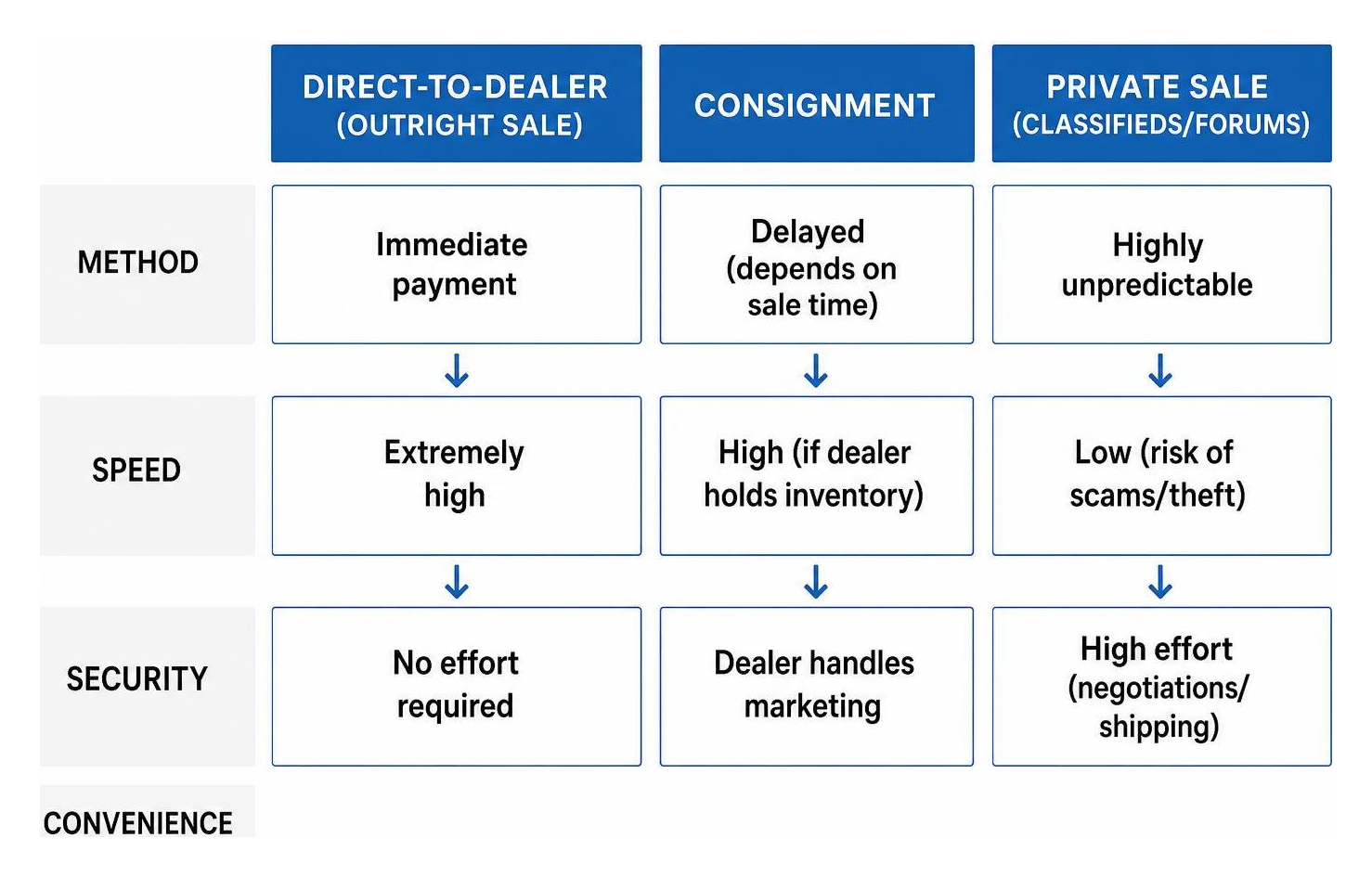
| Feature | Direct-To-Dealer Outright Sale | Consignment | Private Sale |
|---|---|---|---|
| Speed | Immediate, subject to final inspection | Depends on buyer timing | Unpredictable |
| Security | High, handled through an established business | High when the dealer securely holds the watch | Lower, with more personal risk |
| Convenience | Simple process with minimal owner involvement | Dealer manages the sale process | Requires listing, messaging, meetings, and negotiation |
| Likely Return | Clear wholesale market offer | Potentially higher after fees and waiting time | Variable and often affected by negotiation |
At WristWorks, direct-to-dealer outright sales are the primary recommended pathway for most sellers because they offer a clear process, secure handling, and a practical outcome. Consignment can be useful for exceptional pieces where waiting for the right buyer makes sense, but it should remain a secondary option. WristWorks owns 95% of its inventory directly, holds all consigned pieces securely, and handles payments directly, so sellers are not dealing with an anonymous third party.
Preserve Value Before You Sell
If you are not ready to sell yet, the best move is to protect the watch's condition and documentation. Keep the original box, papers, spare links, tags, receipts, and service records together in a safe place. Avoid unnecessary cosmetic changes, especially on vintage pieces, and use qualified service providers when maintenance is needed.
It is also sensible to review the market before making a decision. Recent brand price rises, exchange-rate movements, and local buyer demand can all affect timing. WristWorks' article on the new maths of luxury watch value gives more context on how these moving parts influence resale decisions.
Talk to a Specialist Before You Decide
If you want a clearer view of what your watch may be worth in the Australian market, start with a practical valuation conversation. WristWorks can help you compare model demand, condition, documentation, and current buyer appetite so you can decide whether selling now makes sense.
You can explore WristWorks' curated collection to see the types of watches moving through the market, or contact WristWorks for a straightforward valuation if you are ready to discuss a specific piece.