What Does Mint Condition Watch Meaning Actually Tell You?

A mint-condition pre-owned watch should look exceptionally well preserved, with little to no visible wear and its original case lines still intact. The most reliable way to judge it is to look beyond surface shine and ask how the watch has been handled, serviced, and refinished.
Key Takeaways
- Mint condition describes a pre-owned watch that remains exceptionally close to its original factory appearance.
- Crisp case edges, even lug profiles, and original finishing matter more than a mirror-like polish.
- Box and papers can strengthen provenance and resale appeal, but they do not determine the physical condition grade.
- Close-up photographs and clear service information help buyers spot refinishing, replacement parts, and bracelet wear.
- A carefully presented Rolex Explorer 40 is a useful example of the sharp finishing buyers should look for.
What Mint Condition Means for a Pre-Owned Watch
It helps to treat “mint” as more than a cosmetic label. A watch can look bright after heavy polishing but still have softened case bevels, uneven lug profiles, or muted chamfers. For a truly mint example, the factory brushing, crisp transitions, balanced case geometry, and original metal contours should still be apparent. Repeated or careless refinishing can remove metal and reduce collectability, even when the surface initially looks clean.
A mint watch does not have to be completely unworn, and it does not need its original box and papers to earn a strong physical grade. Those extras can improve provenance, collectability, and resale appeal, but they are separate from the watch’s cosmetic and mechanical condition. When comparing pre-owned watches, use the stated grade as a starting point, then ask for high-resolution photographs and details about refinishing, bracelet stretch, strap-change marks, replacement components, and service history.
Before committing, compare photographs taken from different angles rather than relying on one brightly lit image. Close views of the lugs, clasp, bracelet, bezel, and caseback make it easier to distinguish normal handling from wear that affects the watch’s original shape.
I am Brad Purdy, founder of WristWorks. With a background in mechanics and technical sales, and experience inspecting, purchasing, and supplying luxury watches across Australia, I have seen how much a precise understanding of mint condition watch meaning matters. Careful checks of metal finishing, lug symmetry, and surface preservation help buyers make a more confident decision and protect long-term value.
Understanding Mint Condition Watch Meaning Across Grading Systems
Navigating Australia’s pre-owned luxury watch market is easier when you know how sellers use condition terms. The labels are helpful, but they are not a substitute for close photographs, accurate descriptions, and careful inspection.
What “Mint Condition” Means in Watch Collecting
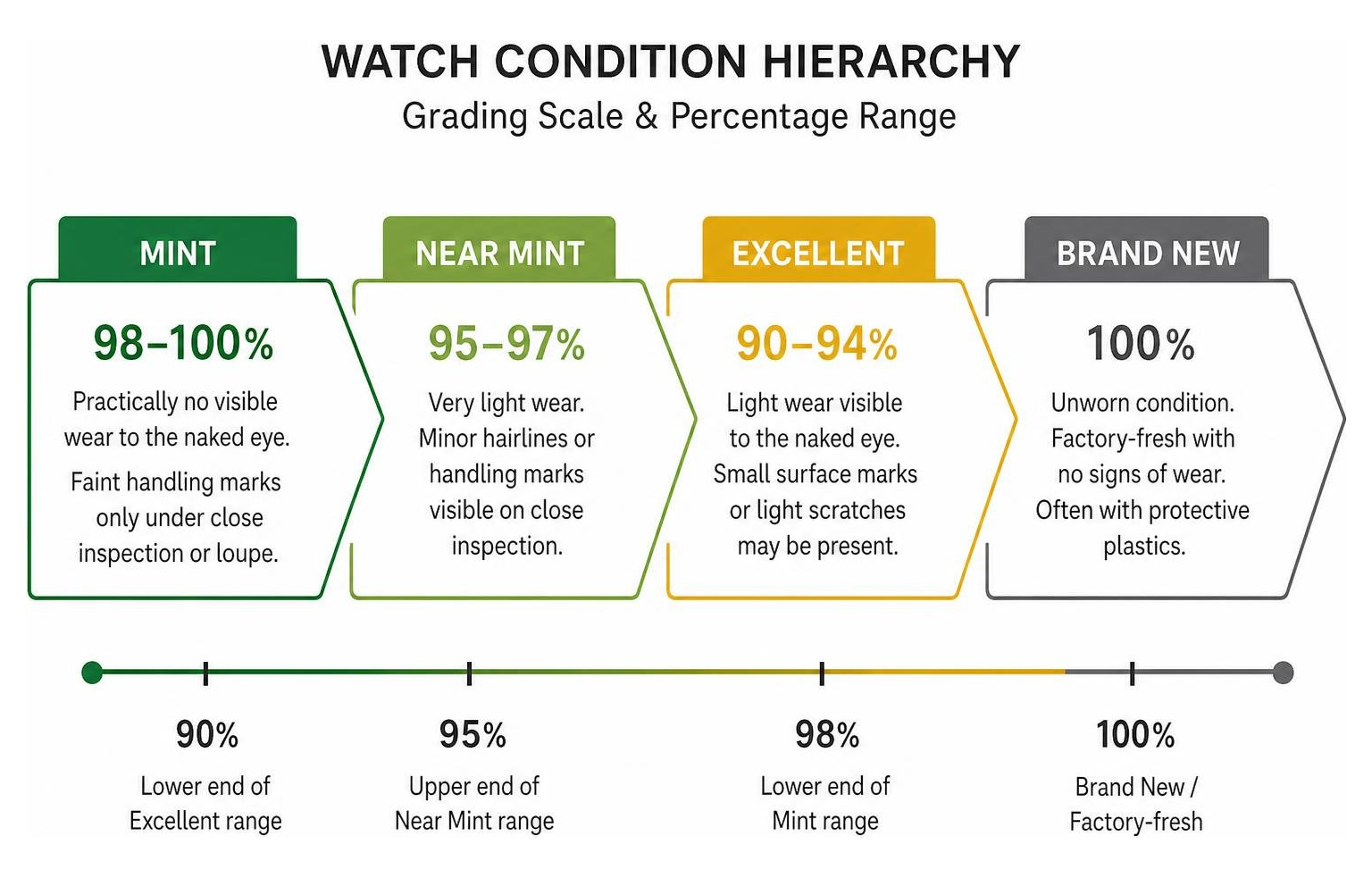
In watch collecting, mint condition usually means the timepiece appears exceptionally close to its original factory state. To the unaided eye, the case, crystal, dial, hands, bracelet, and clasp should present with little or no visible wear. Very light handling marks may only be noticeable under magnification or angled light.
That description should not be taken as a guarantee that the watch is untouched. A well-kept pre-owned watch may have been worn carefully and serviced appropriately. What matters is whether its original proportions, finishing, and components have been preserved.
Condition wording is more useful when you compare it with the age of the watch and the way its materials should naturally wear. A lightly worn bracelet on an older piece may be expected, while an uneven finish, mismatched colour, or distorted edge deserves closer attention. Asking direct questions early helps you avoid making assumptions from a single listing photograph. This is particularly useful when several watches are presented as mint.
Mint, Near Mint, Excellent, and Unworn
Condition descriptions are best read as a practical guide rather than a fixed rulebook:
| Condition Grade | What You Would Expect to See | Case Geometry and Finishing |
|---|---|---|
| Brand New / Unworn | No signs of use and, in some cases, original protective materials. | Factory-original lines and finishing. |
| Mint | Virtually no visible wear, with only extremely light handling marks if any. | Crisp bevels, sharp transitions, and no obvious thinning. |
| Near Mint | Light hairlines or minor signs of careful use, without dents or deep gouges. | Strong overall profile with minor surface contact marks. |
| Excellent | Light scratches or desk wear visible on close inspection. | Clean profile with signs of careful ownership. |
| Very Good / Good | More evident scratches, small dents, or bracelet wear. | Potentially softened edges or prior refinishing. |
A near-mint watch can still be an excellent purchase when its original case shape and factory thickness remain intact. The important point is to compare the description with clear photographs rather than relying on the label alone.
Scratches, Polishing, and Originality
When assessing a mint-condition watch, case geometry often matters more than surface shine. Polishing can reduce the appearance of scratches, but excessive work may soften chamfers, round crown guards, and change the shape of the lugs.
Modern and vintage watches need different considerations:
- Modern watches: Careful refinishing that follows factory tolerances can be acceptable when it retains crisp edges, even satin lines, and original proportions. Rolex Servicing and Refinishing Guidance explains the manufacturer’s approach to maintaining a watch during service.
- Vintage watches: Polishing is generally best avoided. Collectors often value untouched metal, original bevels, and honest age-appropriate patina over a brighter but altered case.
If you are unsure, ask whether the case has been refinished, request macro photographs of the lugs and bezel, and compare both sides of the case for symmetry.
A useful rule of thumb is to slow down when a listing relies on broad phrases such as “mint” without showing the areas most likely to reveal wear. Ask for close images of the case sides, lugs, clasp, bracelet links, crystal edge, and bezel. You can also ask whether the photographs were taken before or after cleaning and whether any components were replaced during service. A seller who can answer these questions clearly gives you a more reliable basis for comparing condition, originality, and value across similar watches. This approach gives you time to weigh the condition description against the evidence, rather than deciding from a polished first impression alone.
Making a Confident Pre-Owned Watch Purchase

Buying a pre-owned luxury watch is more straightforward when you assess the watch, its documentation, and the selling process together. A structured approach gives you clearer information before you decide.
Keep a written record of the details you confirm, including the stated condition, accessories, service information, and any refinishing disclosed by the seller. It gives you a simple comparison point when you are looking at more than one watch or discussing a trade with the dealer.
The Role of Box, Papers, and Factory Components
A mint rating focuses on the physical condition of the case, dial, bracelet, and other visible components. Completeness is a separate consideration, but an original box, guarantee card, manuals, swing tags, and spare links can help document a watch’s history and support its resale appeal.
Treat these accessories as supporting evidence, not a replacement for inspecting the watch itself. Clear photographs of the case, clasp, dial, bracelet, and serial-related documentation give you a better view of what you are considering.
A Practical Buyer Inspection Checklist
Before finalising a pre-owned watch purchase, work through these checks:
- Check case symmetry and bevels: Look at the lugs under angled light. Compare their thickness and shape to see whether previous polishing has altered them unevenly.
- Inspect the crystal and bezel: Check the crystal edge for chips and inspect bezel inserts or fluting for fractures, wear, or softened detail.
- Test bracelet fit and clasp action: Look for excessive droop or stretch, then make sure the clasp closes securely and its detail remains crisp.
- Review lug undersides and screw threads: Marks beneath the lugs can indicate strap changes, while damaged screw heads may point to careless handling.
- Examine the dial and hands: Under magnification, look for moisture marks, fading, debris, or paint defects.
Buying and Selling Through an Australian Specialist
Private sales, online marketplaces, and general auction platforms can make it harder to verify condition, payment arrangements, and the accuracy of a listing. For buyers and sellers who want a more straightforward process, working with an established Australian specialist provides a clearer route from inspection to completion.
At WristWorks, 95% of inventory is owned directly by WristWorks, all consigned pieces are held by WristWorks, and payments are handled directly. Direct-to-dealer, or outright, transactions are the primary option for clients who want to sell or trade efficiently, while consignment remains a secondary service for those who prefer that arrangement.
If you are considering a sale or trade, start with the Watch Trade-In and Valuation Guide. If you are comparing available pieces, you can also Browse Pre-Owned Luxury Watches.
For help assessing a mint-condition watch or arranging an outright sale, Contact WristWorks for clear guidance from the Perth team.