
What Every Collector Should Know About Watch Consignment Payout Timelines
How Long Does a Watch Consignment Payout Take?

A watch consignment payout can take months because payment is only released after the watch is listed, a buyer commits, funds clear, and any agreed inspection period ends. If you want a simpler and faster path, an outright sale to an established dealer can be settled once the watch is inspected and the offer is accepted.
Key Takeaways
- A consignment payout often takes longer than expected because the watch must be prepared, listed, sold, cleared, and released after any return period.
- An outright dealer sale is usually the more straightforward option when timing and certainty matter most.
- Before consigning, ask for the listing period, settlement process, insurance arrangements, and return terms in writing.
- Complete box, papers, and service records can make the assessment process smoother.
- Learn more about Watch Consignment before deciding which route suits your circumstances.
Before you part with a valuable timepiece, it helps to know when it will be listed, when settlement is expected, and what happens if it does not sell promptly. Those practical details have a real effect on how long you may wait. It is worth asking how updates will be provided, who holds the watch while it is listed, and what documents you should retain for your records. Stay organised.
I am Brad Purdy, founder of WristWorks, and my work buying and selling luxury watches, together with my background in sales and finance, shapes how I explain the watch consignment payout timeline. This guide walks you through each stage so you can plan ahead and decide whether consignment or an outright dealer sale better suits your needs.
Why an Outright Dealer Sale Is Often the Simpler Option
For many luxury watch owners, an outright sale to an established dealer is the recommended route. It avoids the uncertainty of waiting for an individual buyer and can be settled within 24 to 48 hours once the watch has been physically verified. There is no extended listing period, ongoing negotiation with prospective buyers, or need to wait for a sale to complete.
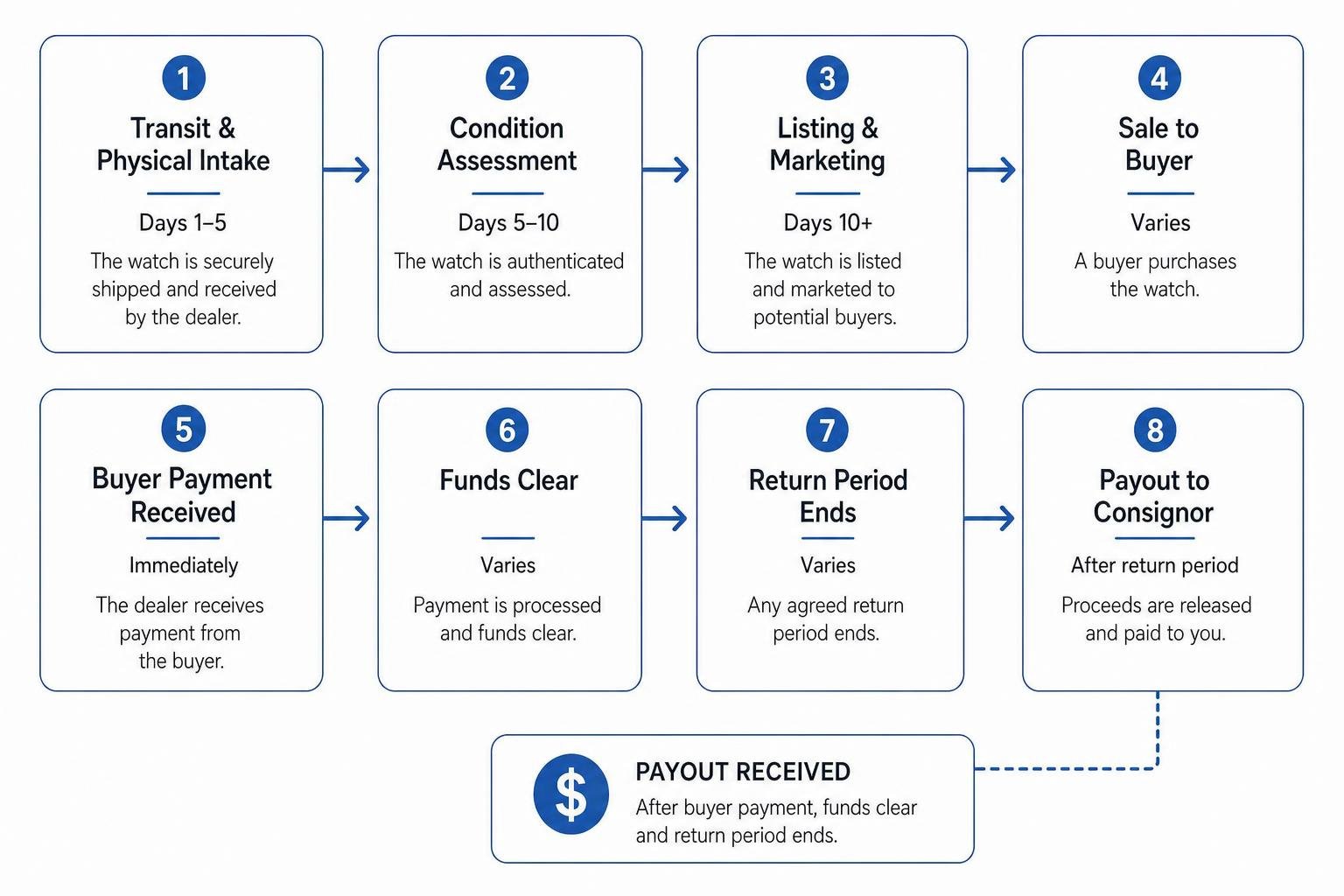
Consignment is a secondary option for selected high-value timepieces when you are comfortable with a longer holding period. Understanding each stage helps you compare that route with the operational simplicity of an immediate dealer buyout. If timing matters, ask whether the dealer can give you a clear outline before you proceed, including the expected assessment period and how updates will be shared during the listing. This comparison clarifies a consignment process and an outright sale.
How the Consignment Timeline Compares With a Direct Sale
A direct sale can be completed soon after inspection, while a consigned watch moves through several stages before settlement reaches you:
- Transit and Physical Intake (Days 1 to 5): The watch is securely shipped, logged into inventory, and catalogued.
- Technical Assessment and Condition Review (Days 5 to 12): Watchmakers assess movement health, timekeeping, water resistance, and overall condition.
- Photography and Listing Preparation (Days 12 to 18): Images, descriptions, and condition notes are prepared for relevant sales channels.
- Market Exposure and Buyer Discussions (From Day 18): The listing remains active while prospective buyers enquire and consider the watch.
- Settlement and Clearance (After a Buyer Commits): Funds clear and any agreed buyer inspection period ends before the payout is released.
| Selling Channel | Typical Time to Agreement | Settlement Timing | Level of Certainty |
|---|---|---|---|
| Outright Dealer Purchase | 24 to 48 hours | Following physical inspection and acceptance | High |
| Luxury Consignment | Often several months | After a buyer commits, clears payment, and completes any inspection period | Varies with the sale process |
Inspection and Return Windows in Consignment Settlements
A consignment payout does not occur the moment a buyer agrees to purchase. Transactions may include an inspection window, often lasting several days, so the customer can review the piece in person.
During this period, the sale is not yet final. Ask how long settlement takes after clearance and make sure the written terms explain insurance, return arrangements, and communication expectations. Our guide to High-End Watch Consignment provides further context.
What Can Extend a Consignment Payout Timeline
Consignment timing can be affected by the watch's desirability, the completeness of its documentation, buyer interest, and the terms of the agreement. With an outright dealer purchase, the dealer takes custody and accepts the responsibility of holding the watch after the transaction is completed.
Documentation and Condition Can Affect Buyer Interest
For Australian sellers considering consignment, buyer interest can vary from one reference to another. Collectors often look closely at a watch's condition, originality, and service history, so clear documentation and accurate descriptions can support a smoother sale process.
Condition also affects how a watch is presented. For modern luxury timepieces, sympathetic cosmetic polishing completed to manufacturer specifications can be appropriate. Vintage timepieces are generally best left unpolished, as refinishing can soften original case details that collectors value.
Complete provenance, including the original presentation box, stamped paperwork, manuals, and service records, can give a prospective buyer greater confidence. Keep these items together before sending a watch for assessment.
Listing Periods and Agreement Terms
A consignment agreement should clearly set out how long the watch may be listed, when the arrangement can be reviewed, and how settlement is handled after a sale. Read these points carefully before leaving the watch with a dealer. It is also sensible to ask who will contact you with updates and what records you will receive once the sale is finalised. You can also confirm where the watch will be stored, how it will be transported, and whether you can end the arrangement if circumstances change before the sale is completed. Keep these details in writing.
Longer listing periods can extend the time between intake and settlement. A clear written agreement helps you understand what happens if buyer interest is limited or the watch remains unsold.
This is one reason an outright dealer sale can be the more reliable route when you want a defined outcome. If you choose consignment as a secondary option, our guide to Negotiating Consignment Agreements can help you prepare the right questions.
Choosing the Right Watch Selling Path
If you want immediate clarity, a straightforward process, and a prompt settlement, an outright dealer buyout is usually the recommended approach. Consignment is better treated as a secondary arrangement for selected watches when you are comfortable waiting for the right buyer.
Comparing Immediate Dealer Buyout to Consignment Waiting Periods
A private sale may seem appealing, but it can involve time-consuming enquiries, shipping disputes, and uncertainty about whether a buyer will follow through. Selling directly to an established luxury watch dealer removes much of that uncertainty and keeps the process more manageable. If you are comparing options, consider how much time you can realistically spend responding to enquiries, arranging delivery, and managing follow-up conversations. A direct dealer sale keeps those steps more contained, which can make the decision easier when you value a clear process from the outset.
When an established dealer buys a watch directly, the dealer takes custody and accepts future market risk. You receive a clear outcome without an extended listing period or ongoing obligations.
| Factor | Direct Dealer Buyout | Consignment Agreement |
|---|---|---|
| Main benefit | Prompt settlement and a clear conclusion | A sale process managed on your behalf |
| Timeline | Usually completed after inspection and acceptance | Can extend while a buyer is found and the sale is finalised |
| Market movement | Dealer accepts the future market risk | Timing depends on buyer interest and the agreement |
| Seller involvement | Limited once the transaction is completed | May require ongoing communication during the listing |
| Custody | Ownership and responsibility transfer after purchase | The watch remains with the dealer while listed |
A direct dealer sale can suit clients who prioritise clarity, certainty, and a more straightforward process.
What to Confirm Before You Consign a Watch
If you decide to consign a timepiece as a secondary option, confirm these safeguards:
- Comprehensive Bailee Insurance: Confirm that transit and on-premises physical loss coverage are in place.
- Unambiguous Title Retention: Legal title should remain with you until final purchase funds clear.
- Defined Settlement Timeline: The written agreement should explain when the payout is released after clearance.
- Clear Return Protocols: Make sure the agreement explains how a returned or withdrawn watch will be handled.
At WristWorks, our business model prioritises immediate inventory acquisitions: 95% of our inventory is owned outright by WristWorks. While we occasionally facilitate bespoke consignment for select high-value timepieces, all consigned pieces are held directly by WristWorks, and payments are handled directly through transparent financial processes.
Whether you decide to sell your watch directly for prompt settlement or discuss tailored consignment terms, understanding the timeline helps you stay in control of the process.
To request a valuation for an outright sale or discuss tailored consignment terms, Contact WristWorks.