Article: The Complete Guide to Watch Consignment vs Selling Outright
The Complete Guide to Watch Consignment vs Selling Outright
Understanding Watch Consignment vs Selling Outright
If you are weighing up watch consignment with selling outright, the simple difference is certainty. An outright direct-to-dealer sale gives you a clear offer and a clean handover, while consignment may leave room for a higher result but usually asks you to wait and accept more market uncertainty.
Key Takeaways
- Selling outright is usually the simpler route if you want a firm valuation, direct settlement, and no ongoing responsibility for the watch.
- Consignment is best treated as a secondary option for select pieces where the owner is comfortable waiting for the right buyer.
- At WristWorks, 95% of inventory is owned directly, and any consigned watch is held by WristWorks with payments handled directly.
- Condition, paperwork, model reference, and market demand all affect whether a direct sale, trade-in, or consignment makes the most sense.
- If you want a straightforward starting point, you can sell your watch through the WristWorks submission process.
How Direct Watch Sales and Consignment Models Function
Selling direct-to-dealer, also called an outright sale, is the more dependable path for most pre-owned luxury watch owners. We assess the timepiece, agree on a fair valuation, and purchase it directly. Once the sale is complete, the dealer takes on the commercial responsibility, holding risk, presentation work, and buyer management.
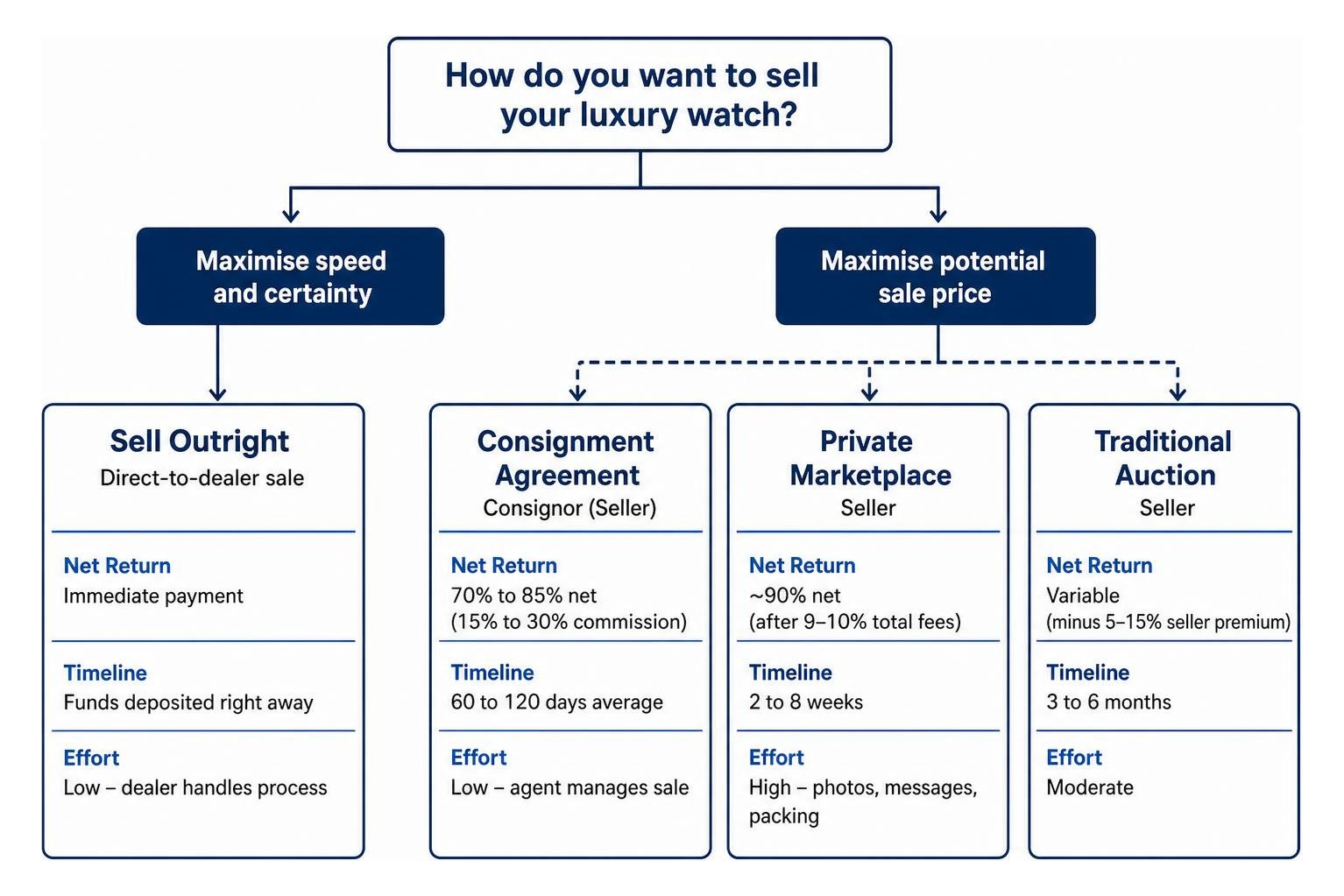
Consignment works differently. You keep legal title to the watch while a dealer presents and markets it for you. The dealer manages photography, enquiries, negotiations, and buyer handling. When the watch sells, the agreed commission or service fee is deducted before the remaining funds are remitted to you.
That structure can suit uncommon or collector-led pieces where the owner does not need fast liquidity. For most sellers, though, the appeal of a direct sale is practical: fewer moving parts, less waiting, and no need to monitor the market while the watch is still unsold.
Other self-managed routes, such as private marketplaces or auctions, can add a lot of work. You may need to handle photography, messages, packaging, insured transport, non-paying buyers, and extended sale schedules. Those routes are worth understanding as comparison points, but they are rarely as simple as selling directly to a reputable dealer.
Key Financial and Practical Differences in Luxury Timepiece Sales
The real question in watch consignment versus selling outright is not just the headline price. It is how much certainty you want, how quickly you want the transaction finished, and how comfortable you are with a sale that may take longer than expected. Secondary watch values can shift with supply, demand, exchange rates, and broader collector sentiment, as shown in market reporting from the Federation of the Swiss Watch Industry.
With an outright sale, the dealer absorbs later market movement. If buyer demand softens after the watch has been purchased, your agreed sale has already been completed. With consignment, that risk remains with you until a buyer commits, funds clear, and the agreed disbursement is processed.
Financial Outcomes of Watch Consignment Versus Selling Outright
For a modern luxury sports reference such as a Rolex Submariner Date 126610LN, the practical differences usually look like this:
| Method | Payout Structure | Realisation Timeline | Seller Effort | Market Risk Absorbed By |
|---|---|---|---|---|
| Direct-to-Dealer Outright Sale | Agreed direct purchase valuation | Prompt direct bank transfer | Minimal assessment and handover | Dealer |
| Dealer Trade-In | Agreed trade value toward another watch | Immediate once the new piece is selected | Minimal | Dealer |
| Consignment Agreement | Net proceeds after agreed commission or service fee | Often longer and buyer-dependent | Low once listed | Seller |
| Private Marketplace | Net proceeds after platform deductions and selling costs | Buyer-dependent | High | Seller |
| Traditional Auction | Final hammer result after agreed deductions | Catalogue- and sale-date dependent | Moderate | Seller |
The important point is that a higher asking price is not the same as a better result. Consignment may look appealing if the listed price is ambitious, but the final outcome depends on buyer interest, agreed deductions, presentation requirements, and whether the market still supports that price when the sale happens.
Timelines, Fees, and Inventory Risk
The practical differences become clearer when you look at what happens after the watch leaves your hands:
- Turnaround and settlement: Direct sales can be completed once the watch has been assessed in person or through secure transit verification. Consignment continues until a qualified buyer is found and the transaction is finalised.
- Fees and deductions: Consignment agreements usually include an agreed commission or service fee. Some may also include handling, presentation, or withdrawal terms, so the net figure matters more than the advertised price.
- Custody and business model: At WristWorks, 95% of inventory is owned directly by WristWorks. For the select pieces accepted on consignment, WristWorks holds the watch in secure physical custody and handles payments directly.
- Condition by era: Modern watches may benefit from careful cleaning or light refinishing against clear watch condition grading standards. Vintage watches are different: polishing is generally avoided to preserve case lines, chamfers, and natural patina.
How to Choose the Right Selling Route for Your Watch
Selecting between an outright sale and a secondary consignment arrangement comes down to your watch, your timing, and how much uncertainty you are willing to carry. If you want a clear process and a finished transaction, direct-to-dealer selling will usually be the better fit. If you have a highly specialised piece and are comfortable waiting, consignment may be worth discussing.
Consider the Model, Completeness, and Demand
Liquidity varies across brands, references, and production periods. High-demand modern references such as the Rolex Submariner Date 126610LN, Rolex GMT-Master II 126710BLRO, and Omega Speedmaster Professional Moonwatch 310.30.42.50.01.002 tend to be easier for dealers to value and purchase outright because comparable market data is stronger.
More specialised watches, such as the Audemars Piguet Royal Oak 15500ST.OO.1220ST.01 or Patek Philippe Nautilus 5711/1A-010, may attract a more selective buyer pool. A dealer can still make a direct purchase offer, but some owners may consider consignment if they are prepared to wait for the right collector.
Completeness also matters. Original boxes, guarantee cards, manuals, and accessories make a watch easier to present and compare. A complete set does not remove the need for careful evaluation, but it usually gives buyers more confidence and can support stronger demand across direct sale, trade-in, and consignment channels.
If you are selling because you want to move into another watch, a trade-in option may also be worth considering. It can keep the process simple while helping you shift from one reference into another without running a separate sale first.
Choosing a Confident Next Step
Before deciding, ask yourself a few practical questions:
- Do you want a firm outcome rather than waiting for a buyer?
- Are you comfortable with the market changing while the watch is still unsold?
- Is your watch complete with its original box, cards, manuals, and accessories?
- Would a trade-in better suit your next purchase?
- Do you want the selling process handled by a dealer rather than managing enquiries yourself?
For most sellers, the simplest route is an outright direct-to-dealer sale because it removes the waiting period and transfers future market risk to the purchasing dealer. Consignment remains useful in the right circumstances, but it should be approached as a secondary option rather than the default.
At WristWorks, the process is built around clear communication, careful evaluation, and straightforward dealer purchasing. If you would like a considered view on your watch, you can submit it for a direct sale or contact the WristWorks team for a no-obligation valuation.