Detailed Guide to Spot a Fake Rolex Daytona
Why Spotting a Fake Rolex Daytona Matters Before You Buy
If you are looking at a Daytona in Australia, knowing how to spot a fake Rolex Daytona can save you from a very expensive mistake. The best replicas now look convincing at first glance, so it helps to know what to check before you hand over any money.
Key Takeaways
- A genuine Daytona has a fixed bezel, solid caseback and screw-down chronograph pushers.
- Dial printing, sub-dial spacing, rehaut engraving and bracelet fit are often where fakes reveal themselves.
- Modern Daytona references need to be checked against their exact model details, not broad Rolex assumptions.
- Paperwork and NFC cards can be faked, so the watch itself matters more than the story around it.
- If you are unsure, have the watch assessed carefully before buying or selling in the Australian market.
There are more fake Rolex watches circulating worldwide than genuine ones. The Daytona sits at the sharp end of that problem because steel sports models can carry large premiums on the secondary market. That gap between retail and resale creates a strong incentive for counterfeiters, and some replicas are now good enough that a quick look at the dial or bracelet is not enough.
The replica market has changed a lot. Better fakes can use convincing steel, ceramic-style bezels and movements designed to imitate the real calibre inside. A buyer who only checks weight or general appearance can still end up with a watch worth a fraction of what they paid. In Australia, where many buyers deal through private sellers, online listings or grey market channels rather than authorised dealers, careful inspection is essential.
I'm Brad Purdy, founder of WristWorks. Learning how to spot fake Rolex Daytona examples has come from years of buying, selling and inspecting watches across the Australian market, including an early $13,000 lesson that shaped the way I check every watch that comes across my desk.
Physical Signs to Check on a Rolex Daytona
When you inspect a Daytona, work slowly and look at the details counterfeiters often struggle to reproduce. The overall shape may look close, but small differences in printing, finishing and fit can tell you a lot.
Dial Details and Sub-Dial Spacing
The dial is one of the hardest parts for replica manufacturers to copy well. On a genuine Daytona, the printing should look crisp and slightly raised under magnification, with clean edges and consistent thickness. Counterfeit dials often show fuzzy lettering, uneven ink or small printing flaws that become obvious under a loupe.
On a genuine modern Daytona, the sub-dials at 3, 6 and 9 o'clock should sit cleanly and evenly. Replicas can show slight drift, where the sub-dials sit too close to the outer edge or look vertically misaligned.
Also check the centre posts in each sub-dial. Some fakes have a crater-like look, where the paint appears sunken or uneven around the post.
The hands should be neatly polished and catch the light smoothly. Replica hands can look flat, dull or rough at the edges under magnification. For broader Rolex checks, read our guide on how to tell if a Rolex watch is real.
Bezel Markings and Ceramic Finish
A modern Daytona such as the reference 116500LN uses a Cerachrom bezel. Rolex moulds the tachymeter scale into the ceramic and treats the numerals with a fine platinum coating, which gives the markings a subtle metallic finish.
On a fake Cerachrom bezel, the numerals often look flat or grey rather than metallic. The fill may also sit unevenly instead of looking clean and flush with the ceramic surface.
For older steel-bezel Daytonas such as the reference 116520, look closely at the engraving depth. Genuine tachymeter markings should be deep, sharp and even. Fakes are often shallow or poorly defined.
Case, Crown Guards and Pushers
A genuine Daytona case has smooth, flowing lines and careful finishing. Rolex uses Oystersteel on modern steel models, and the finish should feel clean, dense and refined rather than tinny or sharp.
Run your fingers along the undersides of the lugs and around the caseback edge. Genuine finishing should feel smooth. Replicas often skip these labour-intensive details and can leave scratchy or poorly finished edges.
The crown guards should taper neatly around the winding crown. On many replicas, they look too blocky, too thick or slightly uneven from one side to the other.
The chronograph pushers must screw down securely. Unscrew them and test the action carefully. On a genuine watch, they should operate smoothly and click cleanly, not feel gritty, loose or spongy.
When it comes to case maintenance, light polishing can be acceptable for modern Daytonas, but we generally avoid polishing vintage pieces because it can soften the original bevelled lines.
Bracelet Construction and Clasp Fit
The Oyster bracelet should feel solid, comfortable and precisely assembled. The links should drape naturally around the wrist without excessive play, rattling or sharp edges.
The solid end-links should sit flush against the case with no obvious gaps. Loose fitment is a common sign that something is not right.
The Oysterlock clasp should close with a crisp mechanical click. On fakes, the clasp can feel mushy or poorly aligned, and the welds or stamped details may look uneven.
| Physical Attribute | Genuine Rolex Daytona | Counterfeit Replica |
|---|---|---|
| Material | Oystersteel or precious metals | Lower-grade steel or weighted alloys |
| Steel Weight | Approximately 116g to 141g, depending on reference | Often lighter on low-grade replicas |
| Bezel Numerals | Metallic platinum-style finish | Flat grey paint or uneven fill |
| Pusher Action | Smooth, crisp mechanical click | Spongy, gritty or loose feel |
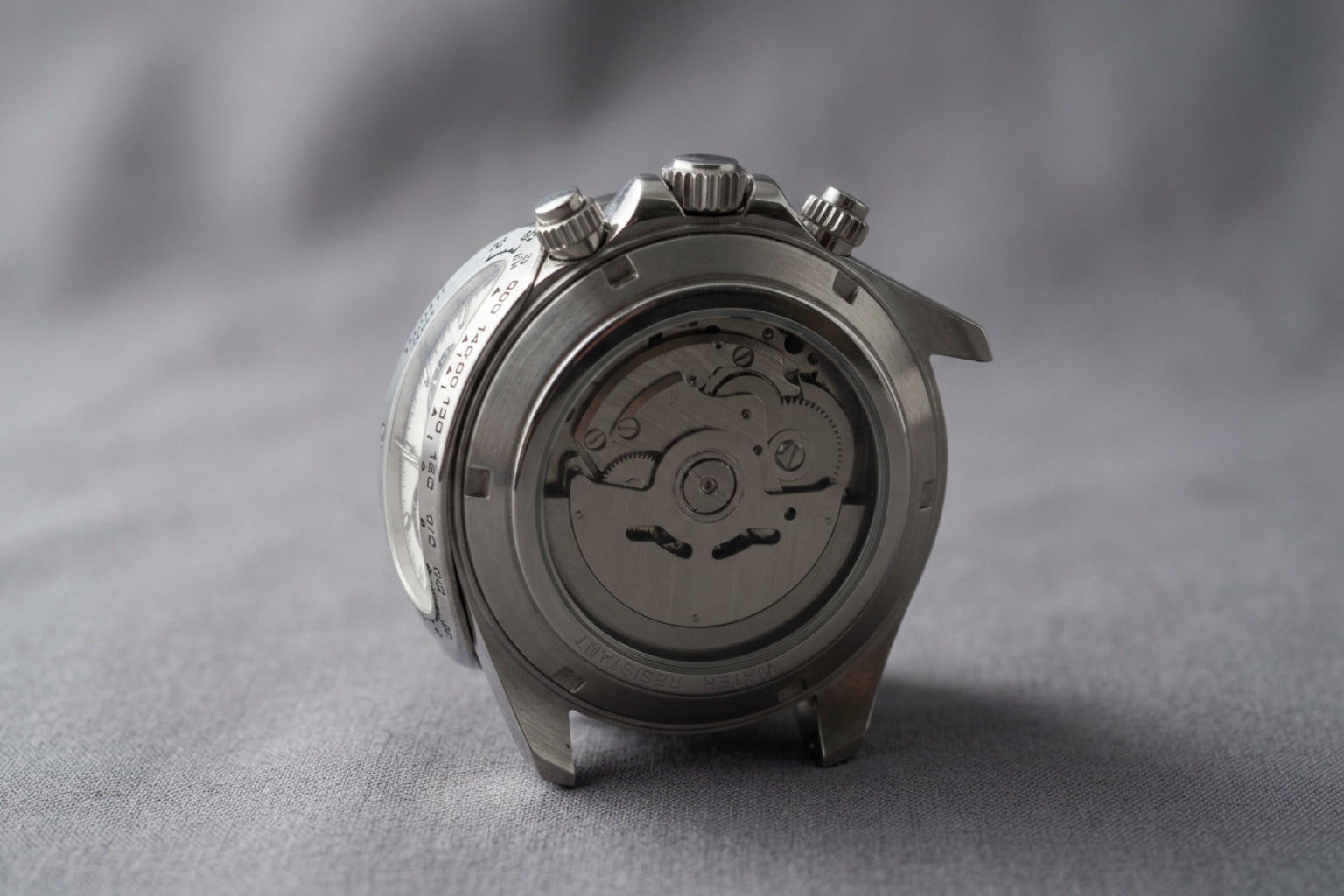
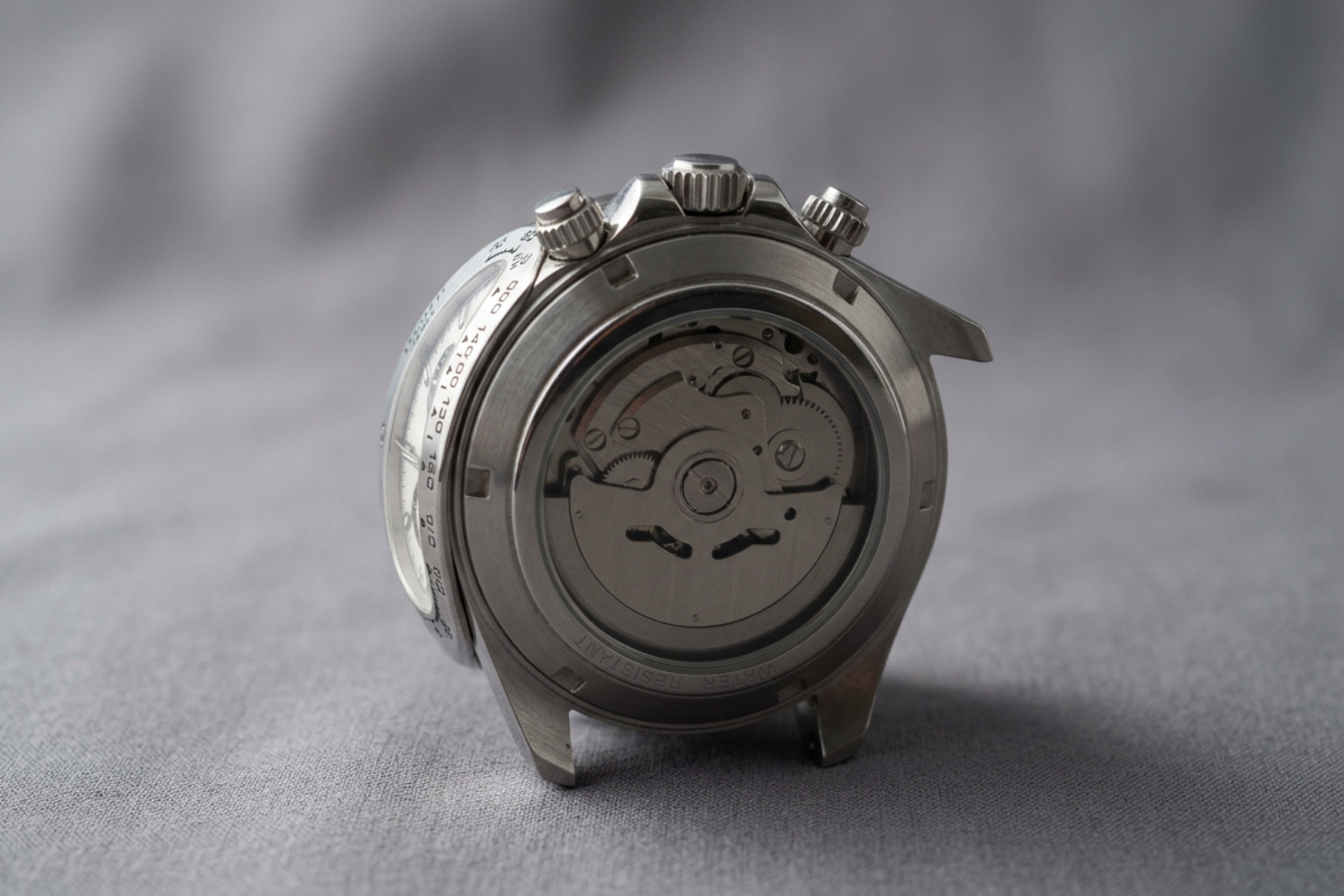
| Caseback | Solid metal | Sometimes glass or exhibition style |
Movement, Serial Numbers and Final Buying Checks
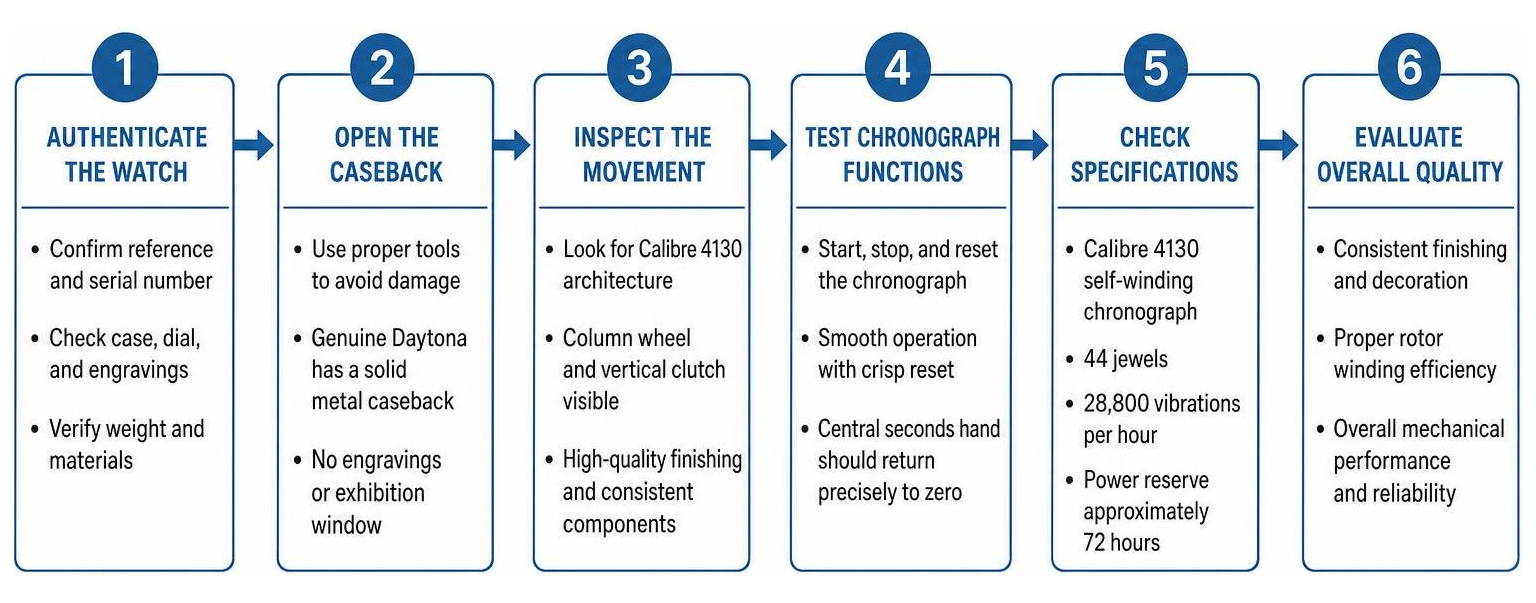
External details matter, but the movement and identifying marks are where a careful inspection becomes even more important. If you are not comfortable opening or assessing a Daytona, it is worth getting specialist help before you buy.
Movement Differences and the Calibre 4130
For over two decades, many modern Daytona models used the Calibre 4130, an in-house self-winding chronograph movement with a column wheel and vertical clutch. It is efficient, neatly constructed and difficult for replica makers to copy properly.
High-end replicas, often called superclones, use movements designed to look like the Calibre 4130. Under close inspection, they still tend to fail on details. One useful mechanical tell is the balance wheel: a genuine Calibre 4130 uses a free-sprung balance with Microstella regulating screws, while many replicas use a cheaper regulated balance with an adjustment arm.
A genuine automatic rotor should also feel quiet and controlled. If you gently move the watch near your ear and hear a loud, loose whooshing sound, that can point to a poorly weighted replica rotor.
You can also test power reserve. A genuine Calibre 4130 is known for a 72-hour power reserve, so a fully wound watch should run for about three days. Many fakes stop well before that. For more general buying checks, read our guide on how to spot a fake Rolex.
Serial Numbers and Rehaut Engraving
Every modern Daytona has engraving on the inner bezel ring, known as the rehaut. The word ROLEX repeats around the ring, and the unique serial number appears at 6 o'clock. On a genuine example, the alignment should be precise and the engraving should look sharp and clean.
Counterfeiters often reuse the same serial numbers across many watches. Searching the serial number online can sometimes reveal that it appears on known replicas, but do not rely on this alone.
Modern paperwork can also be copied. Be especially careful with NFC cards that redirect to a fake validation page. A card or receipt should support the watch, not replace a proper inspection of the watch itself.
Common Daytona red flags include:
- A ticking chronograph hand that suggests a cheap quartz movement
- A glass or exhibition caseback on a production steel Daytona
- A rotating bezel, when the Daytona bezel should be fixed
- Misaligned rehaut engraving or a serial number that appears on known fakes
- Rough, unfinished or incorrect movement details under magnification
Buying or Selling a Daytona With Confidence
At WristWorks, we operate a 100% online model from Perth, Western Australia. We own 95% of our inventory outright, and every watch we hold is personally vetted before it is listed. Consignment is available as a secondary option, but our direct-to-dealer outright model remains the main path we recommend for a simpler and more secure selling process.
If you are weighing up a Daytona purchase or sale in Australia, slow the process down and check the watch properly before making a decision. You can submit a watch enquiry or explore our current Rolex Daytona for sale listings if you would like WristWorks to help assess the next step.