How to Verify Audemars Watch Authenticity in 5 Simple Steps
Why Knowing Your Audemars Piguet Is Real Matters More Than Ever
This Audemars authentication guide covers everything you need to verify whether an Audemars Piguet watch is genuine before you spend serious money on one.
Before getting into the detailed checks, it helps to understand how each sign of authenticity works together. These key takeaways give you a quick framework for spotting obvious red flags before moving into a full professional inspection.
Here is a quick summary of the five key steps:
- Examine the Tapisserie dial and canon pinion under magnification for sharp, precise guilloché work
- Measure case thickness and inspect all eight bezel screws for correct finish and flush seating
- Check the movement for a solid gold rotor and free-sprung balance with no regulator arm
- Decode the serial, model, and movement numbers and cross-reference them against official records
- Verify the full documentation set including the presentation box, registration card, and any archive paperwork
The luxury watch market has changed. Super-clones, highly sophisticated counterfeits built from quality steel, sapphire crystal, and clone movements, are now convincing enough to fool casual buyers and even some dealers. For a watch like the Royal Oak, which regularly trades for tens of thousands of dollars on the pre-owned market in Australia, the stakes of getting it wrong are significant.
What makes this harder is that no single test is enough. A fake can pass a weight check. It can have a clean-looking serial number. It might even have a movement that looks right at a glance. That is why verification requires a layered approach, checking multiple details together, not just one or two in isolation.
I'm Brad Purdy, founder of WristWorks, and after years of buying, selling, and verifying pre-owned luxury watches across Australia, including learning from a costly early mistake that reshaped how I approach every transaction, this Audemars authentication guide reflects the exact process I use to verify every piece before it changes hands.
The Ultimate Audemars Verification Guide: 5 Steps to Verify Your Watch
To protect your investment, we must look past superficial aesthetics. Counterfeiters have access to advanced manufacturing machinery, allowing them to replicate the general weight and look of high-grade stainless steel, gold, and platinum. However, they cannot replicate the hundreds of hours of hand-finishing that define a genuine Swiss luxury timepiece.
By using a systematic verification process, we can look for specific technical anomalies that super-clones fail to hide. The table below outlines the primary physical differences between a genuine Audemars Piguet watch and a modern counterfeit.
| Feature | Genuine Audemars Piguet | Counterfeit Super-Clone |
|---|---|---|
| Tapisserie Pattern | Knife-edge sharp, crisp squares with a subtle sunburst texture. | Rounded corners under magnification; flat, dull texture. |
| Canon Pinion | Convex, mirror-polished cap covering the hand stack. | Flat, wide, unpolished or poorly finished center pin. |
| Case Thickness | Extremely slim (e.g., Jumbo 15202 is exactly 8.1mm). | Noticeably thicker (usually 8.5mm or more) due to clone movements. |
| Bezel Screws | Made of solid white gold; sit perfectly flush with the bezel. | Made of stainless steel; often sit proud or unevenly recessed. |
| Winding Rotor | Solid 18k or 22k gold; heavy weight with deep, clean engraving. | Gold-plated brass or tungsten; lighter weight and shallower engraving. |
| Balance Wheel | Free-sprung balance wheel without a visible regulator arm. | Regulated balance wheel with a visible adjustment index arm. |
1. Dial and Tapisserie Details: An Audemars Verification Guide Step
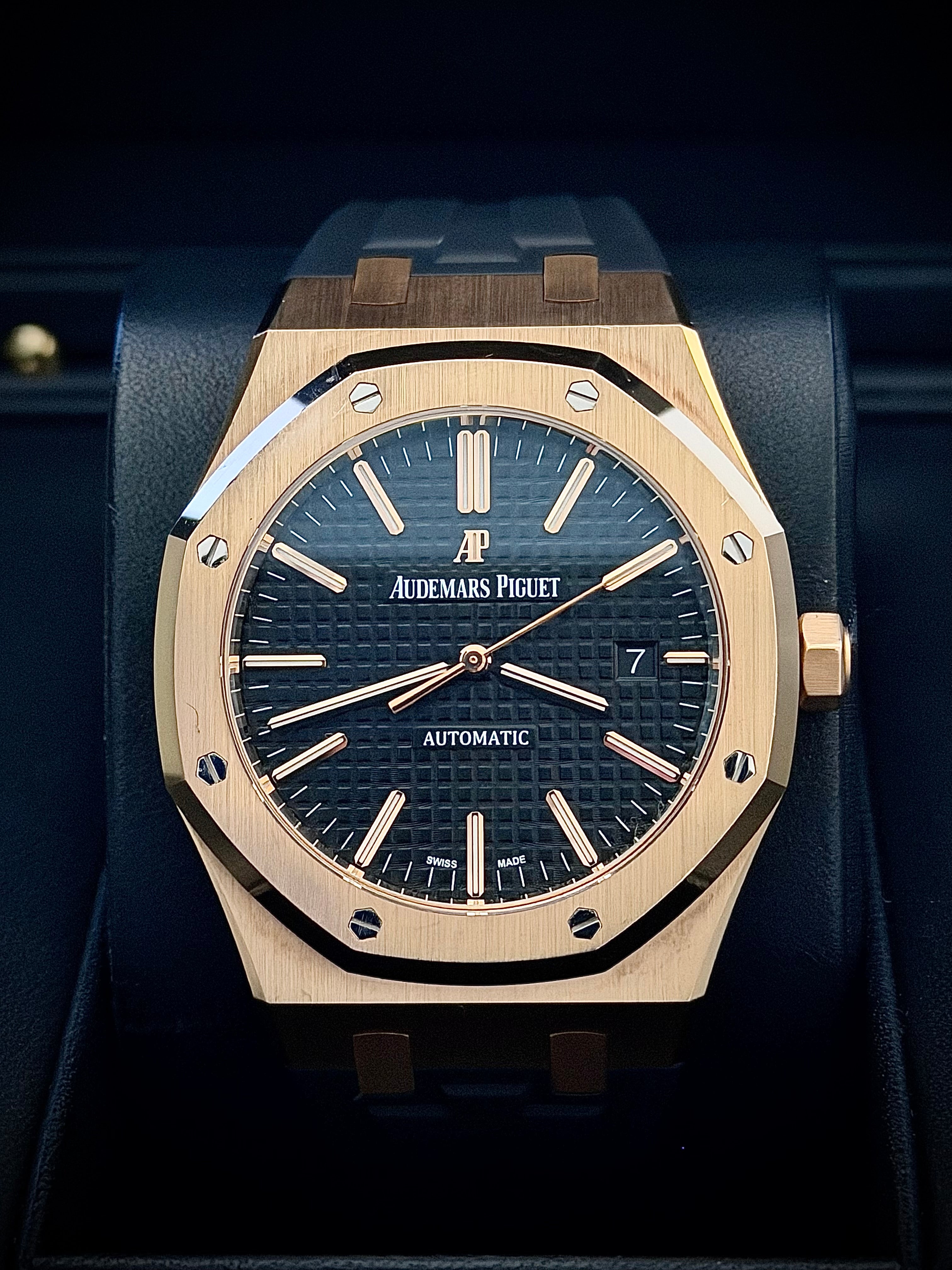
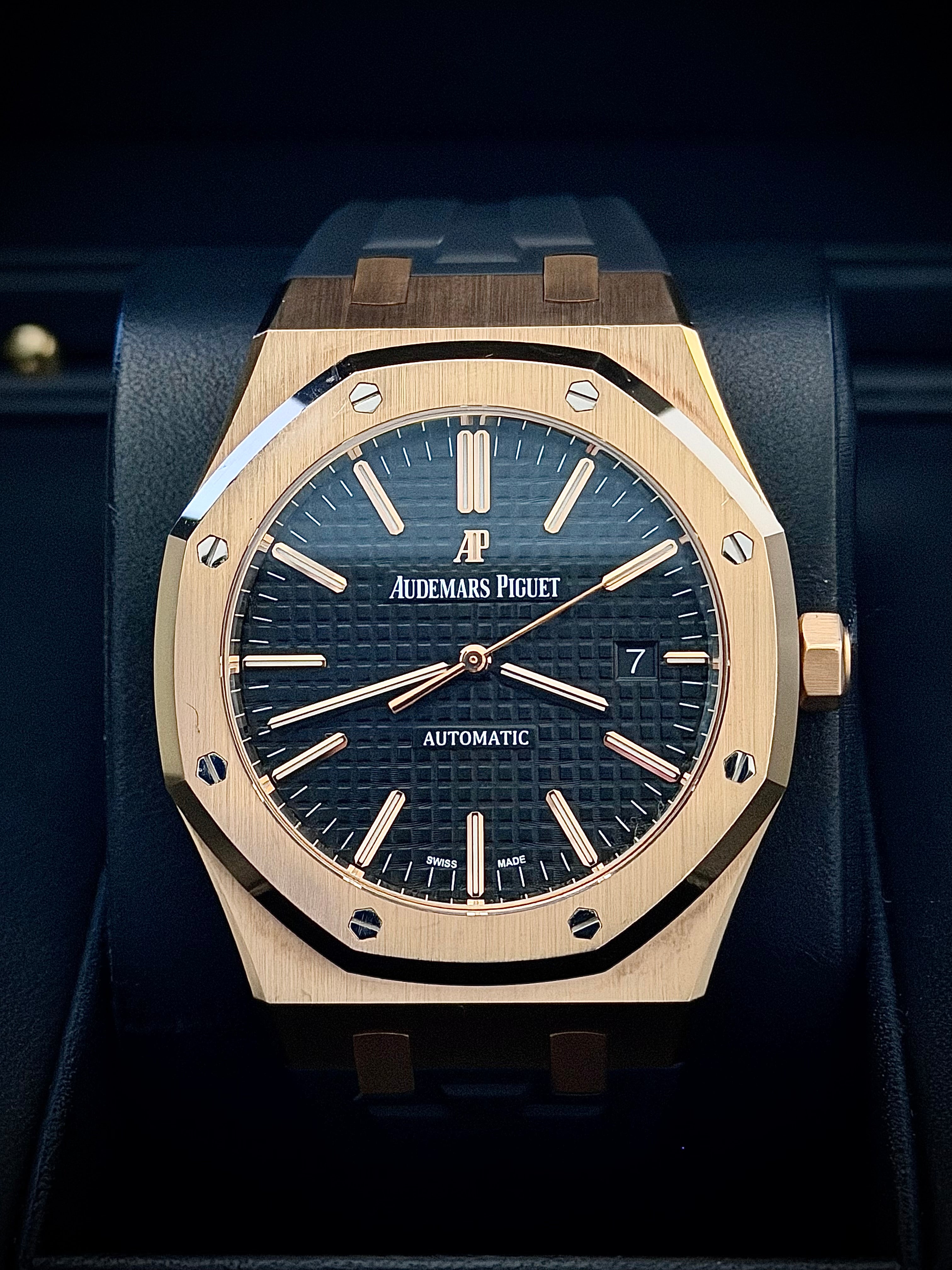
The dial of a Royal Oak is its calling card. The iconic "Tapisserie" pattern, whether it is the Petite, Grande, or Méga Tapisserie, is created using a rare, vintage 3D engraving technique. This process uses a pantograph machine that copies a master pattern onto the dial, cutting tiny square pyramids while simultaneously engraving thousands of microscopic diamond shapes in the grooves between them.
Under a 10x jeweller's loupe, a genuine dial shows knife-edge sharp corners on every single square. When you rotate the watch in hand, these squares catch the light to produce a very subtle "sunburst" effect. Counterfeits, on the other hand, are typically made using cheap stamping or modern CNC milling. This leaves the edges of the squares looking rounded, soft, and flat.
Another crucial tell is the "canon pinion", the central pin that holds the hour and minute hands. On a genuine piece, the canon pinion is covered by a convex, mirror-polished cap that looks perfectly rounded and smooth. Super-clones often feature a flat, wide center pin, sometimes referred to as a "pizza hand" base, because their movements are not refined enough to accommodate the delicate hand-stacking of a genuine caliber. For a deeper dive into these visual discrepancies, you can read our guide on Spotting a Fake Audemars Piguet: Your 6-Step Guide to Guaranteed Genuineness.
2. Case Dimensions, Thickness, and Bezel Screws
One of the most reliable ways to separate a genuine Audemars Piguet from a replica is to measure its physical dimensions. The Royal Oak is famous for its incredibly slim profile relative to its complexity.
For instance, a genuine "Jumbo" Extra-Thin reference 15202 measures exactly 8.1mm in thickness. Because counterfeiters are forced to use thicker, modified clone movements to replicate the dial functions, their cases almost always exceed 8.5mm. When verifying a watch, we always recommend using a digital caliper to measure the case thickness down to the decimal point. If the watch is even half a millimeter too thick, it is a clear red flag.
Next, examine the octagonal bezel and its eight signature hexagonal screws. On a genuine steel Royal Oak, these screws are actually made of solid white gold, giving them a slightly warmer, brighter lustre than the surrounding stainless steel. They must sit perfectly flush with the bezel surface, neither protruding nor deeply recessed. Counterfeiters often use polished stainless steel screws that sit unevenly or leave noticeable gaps around their edges. For more on these exterior details, refer to our breakdown on How to Spot a Fake AP Watch.
When evaluating the case and bezel, it is also important to consider the overall finish and wear. For modern Audemars Piguet models, professional polishing is entirely acceptable to restore the sharp, brushed surfaces and mirror-polished bevels to their original factory standard. However, for vintage pieces, polishing is generally avoided. Collectors highly favour the original, unpolished edges and sharp case lines of vintage watches, as excessive polishing can permanently alter the case profile and diminish its historical value and appeal.
3. Movement Architecture and Gold Rotor: Audemars Verification Guide Tips
If the watch has an exhibition caseback, the movement offers the most definitive answers. Genuine modern calibers, such as the Caliber 3120 or Caliber 4302, are masterpieces of high-end Swiss watchmaking.
First, look at the winding rotor. A genuine Audemars Piguet rotor is crafted from solid 18k or 22k gold. This precious metal provides the necessary weight for highly efficient automatic winding and displays a rich, warm hue. Clone rotors are almost always made of gold-plated brass or tungsten, which lacks the correct weight and often exhibits a dull or overly brassy colour.
Next, inspect the balance wheel assembly. Genuine modern calibers utilise a free-sprung balance wheel, which regulates time using small weights on the balance rim itself. This means there is no regulator arm, the small lever used to adjust the hairspring length, visible on the balance bridge. Counterfeit movements almost always rely on a standard regulated balance, which includes a highly visible index adjuster arm.
Finally, look at the finishing. A genuine movement features flawless hand-applied decoration, including circular graining (perlage), Geneva stripes (Côtes de Genève), and polished bevelled edges (anglage). Replicas often show coarse, machine-stamped patterns with rough edges and tiny metal shavings left behind. The anglage on a genuine movement is particularly difficult to replicate, as it requires skilled craftsmen to hand-polish the bevelled edges of the bridges to a mirror finish. To learn more about how Swiss movements compare to pre-owned market standards, check out A Guide to Buying Pre-Owned Audemars Piguet Watches in Australia.
4. Decoding Serial, Model, and Movement Numbers
Every Audemars Piguet watch is tracked by a unique combination of numbers that act as its digital fingerprint. Understanding how these numbers are structured is a crucial element of this Audemars authentication guide.
Historically, modern Audemars Piguet serial numbers follow a letter prefix followed by a series of numbers (for example, F12345 or J12345). The letter corresponds to a specific production series and chronological era:
- G Series: Approximately 2008 – 2010
- H Series: Approximately 2011 – 2013
- I Series: Approximately 2013 – 2016
- J Series: Approximately 2016 – 2017
In 2017, starting with the K series, the brand transitioned to random, non-sequential alphanumeric serial numbers to make counterfeiting more difficult. You can read more about this transition on the Audemars Piguet Watch Numbering: AP Chronicles archive.
When verifying a watch, you must cross-reference the serial number engraved on the exterior caseback with the movement number engraved on the caliber itself, as well as the reference number. If the serial number indicates a production year that does not align with the movement caliber or the reference style, the watch is likely a counterfeit or a "Franken-watch", a piece assembled from a mix of genuine and fake parts. For collectors looking to trade in Western Australia, our Pre-Owned Audemars Perth Buyers Guide offers excellent localised context on checking these identifiers safely.
5. Verifying Documentation, Archive Extracts, and Packaging
While a counterfeit box and paperwork can be bought online, analyzing the full set can still reveal important clues. A genuine presentation box is incredibly heavy, featuring a flawless, lacquered wood finish, an embossed gold logo, and a plush, high-quality leather or suede interior. Counterfeit boxes often smell strongly of cheap adhesives, use synthetic leather that creases easily, and feature sloppy, uneven gold foil printing on the logo.
Modern Audemars Piguet watches come with a digital, NFC-enabled registration card. This card allows the owner to register the watch directly to their profile on the official Audemars Piguet app, providing instant digital verification.
If you are looking at a vintage or neo-vintage piece that lacks its original papers, the ultimate security measure is to request an official Extract from the Archives directly from the manufacturer. Audemars Piguet maintains exhaustive production registers dating back to their earliest days. For a fee, their heritage department will verify your watch's serial and movement numbers against their physical books and issue an official document confirming its historical build details. This archive verification is a major factor in preserving long-term value, as discussed in our guide on Audemars Piguet Resale.
Why Professional Audemars Piguet Verification Is Worth It
While this five-step guide gives you the tools to spot low-to-mid-tier replicas, the reality of the modern pre-owned market is that "super-clones" can sometimes bypass basic visual checks. No DIY inspection can replace the security of professional equipment, such as digital timing machines, water resistance pressure testers, and high-magnification laboratory microscopes. Attempting to verify a high-value timepiece on your own carries significant financial risk, especially when dealing with private peer-to-peer sales where recourse is virtually non-existent.
Many general high-street jewellers lack the highly specific brand experience required to spot a top-tier fake. To ensure absolute peace of mind, we always recommend bypassing the risks of private sales and DIY verification in favour of a professional, structured process.
At WristWorks, we operate a 100% online model designed to make luxury watch trading transparent, simple, and secure for Australian collectors. We focus on delivering unmatched quality, security, convenience, and customer satisfaction through our rigorous multi-point inspection processes.
Rather than dealing with the stress, potential scams, and long waiting periods of private sales, our primary recommendation for sellers is our direct-to-dealer model. We buy high-quality timepieces outright, offering a fast, secure, and straightforward transaction that removes all the guesswork. For those who prefer other avenues, we also offer consignment as a useful secondary option. To maintain our strict standards, all consigned pieces are held securely by WristWorks, and all payments are handled directly by us. It is also worth noting that 95% of our active inventory is owned directly by WristWorks, ensuring we have complete control over the quality and provenance of the watches we offer.
If you are looking to buy, sell, or trade with complete confidence, explore our curated collection of luxury watches today or get in touch with us to request a professional valuation.